
What Needs to Go So You Can Grow?
Easy hobbies don’t hold much interest for my husband and business partner, Ian. A sampling of his pursuits includes watercolor painting, DSLR photography, and woodworking. And now another fitting pastime has entered the mix: bonsai.
He’s always been a fan of Asian art, so I can see why this particular form appeals to him. It’s art in partnership with nature. It requires patience, attention, and care.
Right now, he’s very much in student-mode—experimenting, learning from each small step (or snip as it were), and admiring the masters who have spent decades tending to trees that have become natural masterpieces.
I’ve been learning a little by proximity and, as I’ve observed this practice, I see striking similarities to a principle we try to embody in our work: You cut back the tree so it can grow stronger.
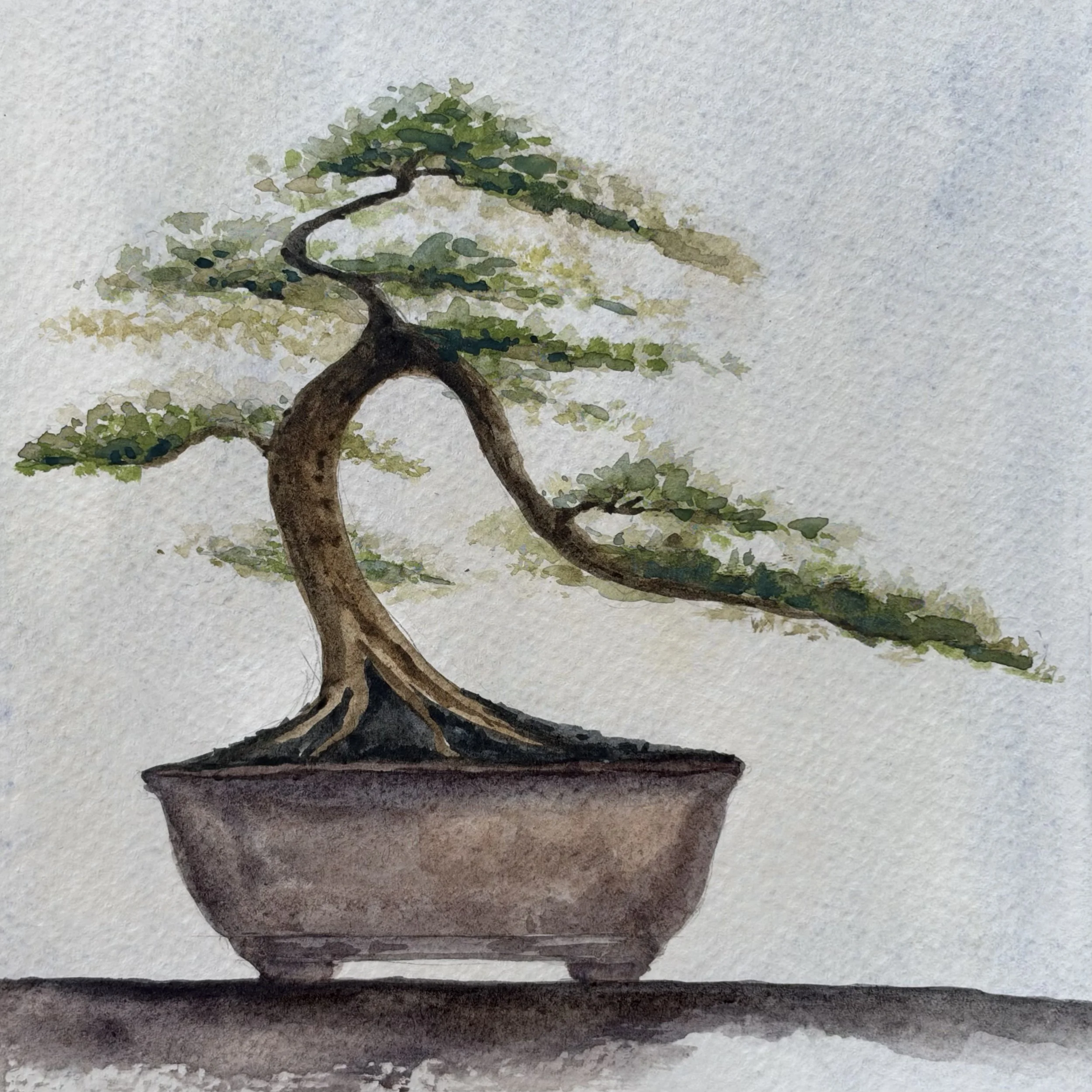
Growing Stronger, watercolor by Ian Mutton
Pruning is an essential part of bonsai. You pay attention to where the tree is putting its energy and make thoughtful cuts to shape what happens next.
Ian has even taught me about something called “back budding.” In this technique, you cut back a branch to foster new growth closer to the trunk. It redirects the tree’s energy and creates the conditions for stronger growth.
In our consulting work, we’ve observed that organizations can benefit from this principle, too. Trouble is, we mere humans are much better at adding than subtracting. And what makes subtraction particularly difficult for us is that the things weighing us down often aren’t bad things at all. Sometimes, it’s simply a case of too much of a good thing—when something intended to be a benefit starts to become a burden.
Think about strategy. Maybe pruning a long-standing initiative is what allows you to fully fund the two priorities that could really move the organization forward. The question isn’t just a matter of, “What can we stop doing?” It’s also, “Where do we most need our energy to go?”
With process, we often see the bottlenecks everyone complains about or the extra steps people have implemented as a workaround. Pruning away the barriers can clear the path to simpler, more streamlined solutions.
Metrics need pruning, too. We can count a lot of things, but a long list of numbers can give us the illusion of impact, while leaving the most important question unanswered: Is our work actually making the difference we intend it to make?
And then there are people. We add meetings, learning opportunities, new tools, team activities—all because we want to support them. But every opportunity also requires time and attention. At some point, support can become another source of overload. Investment only helps if people have the space to benefit from it.
I’m sure you see the trend. Every program, priority, process, metric, meeting, and opportunity may be perfectly defensible on its own. But your organization carries the weight of all of them together.
This is where the lessons of bonsai can be particularly useful. The masters don’t just grab the shears and start clipping. They first have to identify what they’re trying to cultivate.
Bonsai is a practice, and Ian is still learning which cuts will produce which results. And that’s part of the lesson, too. It requires attention and ongoing tending, as well as the willingness to proceed with uncertainty about the outcome and make adjustments as things unfold.
If this has you thinking about what you may may need to prune, take our four-minute Grounded Growth Assessment to find out what intentional cut can strengthen your leadership.